

Some albums are written. Others are clawed out of the wreckage of a life that tried to end before it truly began. The Dysphoria Riot is the latter.
For years, Jynx deLygh has been a ghost in the machine of Austin’s underground, a specter haunting the stages with a mission. This album is the culmination of a methodical, years-long pilgrimage across the city’s sonic landscape, collaborating with a collective of Austin’s fiercest bands to build a cathedral of sound big enough to hold the chaos of a life in transition.
This is not a collection of songs; it is a survival guide burned onto a digital music album. It is the requiem for the girl Jynx was told she couldn’t be, and the war cry of the woman who fought her way into existence anyway. Here, you will find the needle scars and the bottle rockets, the graves of friends lost to the darkness, and the raw, bleeding nerve of dysphoria.
But most of all, The Dysphoria Riot is a sledgehammer aimed at the "conservative machine." It is a sonic uprising against the MAGA wave, a two-fisted rebellion against fascism, and a middle finger to every hater who believes the LGBTQIA+ community is going to fade away. We aren't going anywhere. We are rioting.
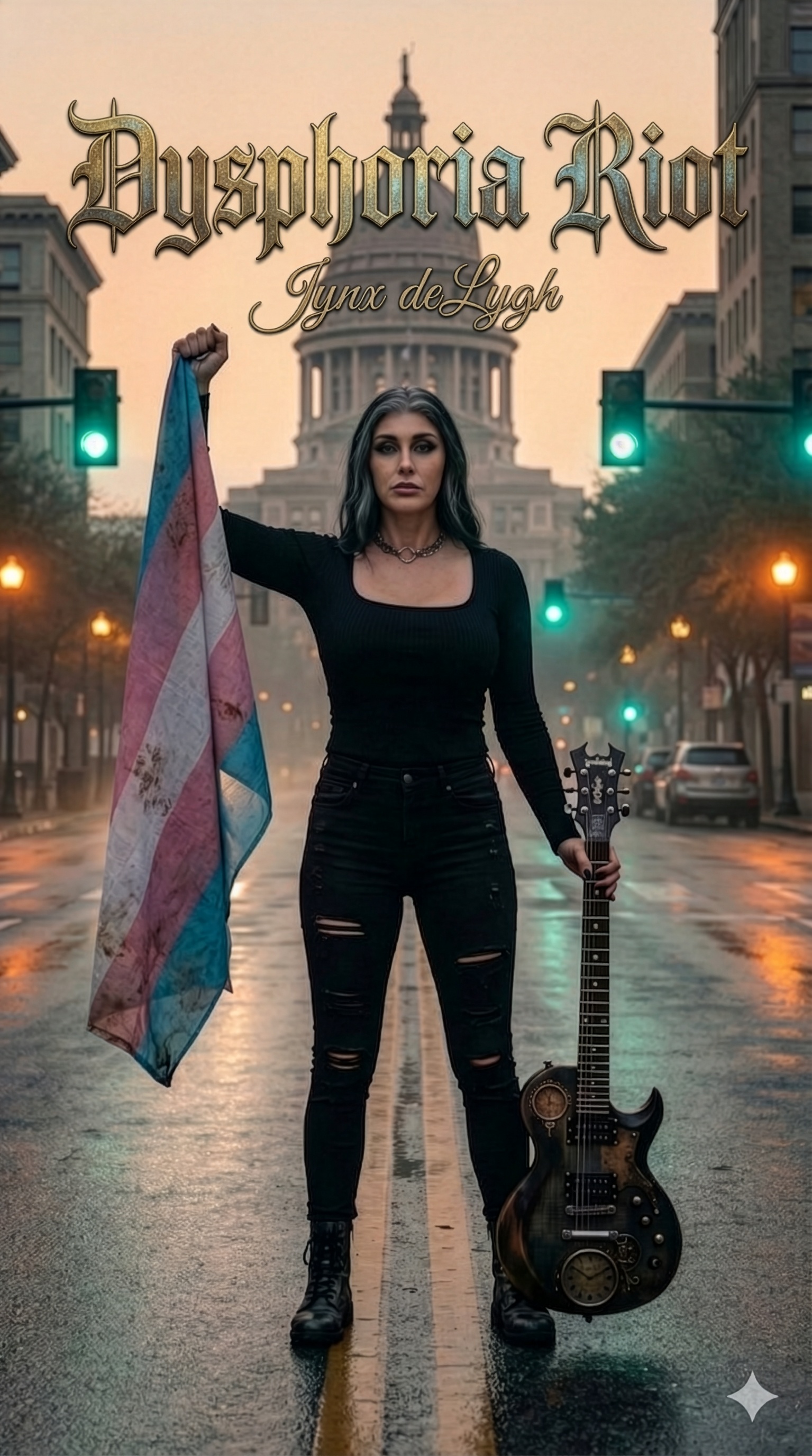
In an era where the very existence of the transgender community has been reduced to a political talking point—a legislative target for authoritarian wannabes and a moral panic for the theocratic fringes of the alt-right—music has always served as our great equalizer. It is the weapon we wield when the courts fail us, the shelter we build when the churches slam their doors, and the diary we scream into when the world refuses to listen.
Enter Jynx deLygh.
On 03/27/2026, deLygh is set to unleash Dysphoria Riot, an album that is less a collection of songs and more a declaration of war wrapped in the sonic aesthetics of early 2000s post-hardcore and pop-punk nostalgia mixed with the heaviness of atmospheric emo. But do not let the familiar crunch of the guitars or the anthemic nature of the hooks fool you. Dysphoria Riot is not here to be a passive listening experience; it is here to soundtrack a movement.
At a time when the United States is witnessing an unprecedented wave of legislative attacks aimed at erasing trans existence—from bathroom bans to the outright denial of gender-affirming care—Jynx deLygh has crafted a record that meets the moment with the ferocity it deserves. The album’s title is a thesis statement. “Dysphoria” speaks to the internal, deeply personal struggle of existing in a body that the world tells you is wrong. “Riot” is the external, collective response to that oppression.
Spanning 10 tracks, Dysphoria Riot is a post-hardcore masterpiece that seamlessly blends the genre’s characteristic dissonance and angular riffs with the sticky, melodic sensibility of pop-punk. It is an album that sounds like the spiritual successor to Relationship of Command if it had been raised on a diet of Take This to Your Grave and a righteous, unyielding fury against the Christian nationalism currently infecting the American landscape.
The Battle Against Organized Hypocrisy
Perhaps the most striking element of Dysphoria Riot is its unflinching willingness to name the enemy. In an industry where artists are often encouraged to be “palatable” or to “stay out of politics” to protect their streaming numbers, deLygh does the opposite. The album’s second single, “Altar of the Alt-Right,” is a blistering, two-and-a-half-minute assault on the unholy alliance between the far-right political machine and fundamentalist religious institutions.
Built on a descending post-hardcore riff that feels like a building collapsing, deLygh screams about the hypocrisy of pulpits that preach love while funding hate. The track doesn’t just criticize; it mourns. It mourns the friends lost to conversion therapy, the trans youth kicked out of their homes by “devout” parents, and the sanctimonious politicians who use the Bible as a bludgeon while ignoring the tenants of empathy that were supposed to define their faith.
But the album is too intelligent to simply be a protest record in the traditional sense. DeLygh understands the psychological warfare of the current moment. The slow-burning, atmospheric track “Gaslight Elegy” tackles the insidious nature of the “alt-right pipeline.” It details the slow radicalization of communities, the erosion of empathy through algorithm-driven hate, and the exhaustion of having to justify one’s humanity on a daily basis. It is a heavy ballad in the truest sense—not just slow in tempo, but heavy in weight. The production here is sparse; deLygh’s vocals are layered, echoing the feeling of screaming into a void that refuses to scream back.
Finding Love in the Wreckage
What elevates Dysphoria Riot from a simple protest album to a timeless piece of art is its second act. Just when the listener begins to feel the suffocation of the political, the album pivots. It remembers that the trans experience is not solely defined by trauma, but by joy, by resilience, and by the radical act of finding love in a world that wants you to hate yourself.
The beginning of the album, marked by the track “Paper Doll Cutout,” serves as a bridge between the depression and the redemption. It is a hardcore pop-punk anthem in the vein of Jynx’s most defiant moments, detailing the journey of peeling back the layers of performative masculinity or femininity forced upon us by society. It is about finding the real self buried beneath the expectations.
From there, the album blossoms into a narrative of found family and queer love. “Safe Word (Not a Metaphor)” is a standout track that has already been generating buzz in early listening parties. On its surface, it is a playful, high-energy love song about trust and intimacy within the kink and trans community—a subject rarely treated with such earnestness in mainstream rock. But lyrically, it doubles as a metaphor for the boundaries we must set with a society that feels entitled to our bodies and our histories. It is sexy, it is loud, and it is unapologetically joyful.
“t4t” (a clever call to a time when dating happened on craigslist) is the album’s emotional adventure. It is a atmospheric-driven post-hardcore ballad that builds to a crescendo of distorted guitars and group vocals. It tells the story of two trans individuals finding solace in each other, becoming each other’s sanctuary when the outside world becomes a battlefield. It is here that deLygh’s vocal range shines brightest—moving from a whisper of vulnerability to a roar of solidarity. This is the track that will have crowds holding up lighters (or, more appropriately for the era, cell phones) at live shows, arms around strangers, screaming the chorus back at the stage.
A Unifying Call to Arms
The overarching narrative of Dysphoria Riot is one of coalition building. In an era where the “divide and conquer” strategy of the alt-right seeks to splinter the LGBTQIA+ community—pitting trans people against cisgender gays, or BIPOC against white queers—Jynx deLygh argues for unity.
The album’s title track, “Dysphoria Riot!,” is the sonic embodiment of a protest march. Featuring guest vocals from other trans and non-binary artists from the hardcore and punk scenes, the song is a polyphonic explosion. It incorporates field recordings from actual protests, and recordings of the hateful vitriol that comes from conservatives, blending seamlessly into blast beats and breakdowns. It is a call to arms that explicitly states: there is no liberation for some of us without liberation for all of us.
For the LGBTQIA+ community, this album arrives as a vital organ. We are currently facing a coordinated assault from authoritarian forces who wish to push us back into the shadows. They are using the levers of government, the pulpit of the church, and the megaphone of social media algorithms to create a hostile environment designed to break our spirit. Dysphoria Riot is the answer to that.
Music has always been the bedrock of queer survival. From the underground ballrooms of the 80s to the riot grrrl movement, from Sylvester to Against Me! (whose Laura Jane Grace paved the literal road for artists like Jynx deLygh), we have always used sound to fight back. Dysphoria Riot enters this lineage with a clear-eyed understanding of history and a forward-looking vision for the future.
The Power of the Heavy Ballad
One cannot discuss this album without addressing the sheer sonic craftsmanship of the “heavy ballads.” Tracks like “Sleepyhead” and “Speaking Love” showcase deLygh’s ability to build tension like a thriller writer. “Sleepyhead” begins with a clean, melancholic arpeggio —a deliberate sonic choice that sets the stage for a story of immense loss and pain. As the song progresses, the distortion creeps in, not as a sudden explosion, but as a slow, suffocating crawl, mirroring the way depression gradually tightens its grip.
These ballads are “heavy” not because of the volume of the guitars, but because of the weight of the subject matter. They force the listener to sit in the discomfort of the reality deLygh describes. They are the sound of endurance. They are the sound of grit. They are the sound of waking up every day in a country where your existence is being debated in school boards and statehouses, and deciding to live loudly anyway.
More Than an Album
Dysphoria Riot is not merely a collection of songs; it is a survival guide, a protest sign, and a love letter all rolled into one. Jynx deLygh has managed to do something extraordinarily difficult: create a piece of art that is fiercely political without sacrificing an ounce of musicality or emotional depth.
For the trans community, this album will serve as a mirror, reflecting both our pain and our profound strength. For the wider LGBTQIA+ community and our allies, it serves as a rallying cry. We are at a precipice. The alt-right authoritarians are organized; they are well-funded; they are relentless. But as Dysphoria Riot makes abundantly clear, we have something they do not: the truth of who we are, the power of authentic love, and the unbreakable rhythm of a community that knows how to fight.
Jynx deLygh has given us the soundtrack for the next chapter of this struggle. Turn it up. Let the neighbors hear it. Let the politicians hear it. Let the hypocrites hiding behind the altar hear it.
We are here. We are not going anywhere. And we are riotous.
Dysphoria Riot will be available on 03/27/2026 via Blåhaj Records. Pre-orders are available now at https://jynxdelygh.com. Jynx deLygh will be embarking on the “Authenticity Tour” starting late 2026 with a portion of proceeds benefiting the Kind Clinic in Central Texas.
For media inquiries, interviews, or review copies, please contact:
Jynx deLygh
outreach@jynxdelygh.com
TT:@the.goddess.jynx | IG:@the.goddess.jynx | Snap:@thegoddessjynx | Ytube:@thegoddessjynx